Tameside and Glossop NHS Trust Deploys GrayOS for Clinics Module Through HICSS Partnership
Tameside and Glossop Integrated Care NHS Foundation Trust went live with GrayOS Clinics on January 27, 2026, becoming the first NHS trust to deploy the module in an endoscopy setting. It runs within the HICSS Endoscopy Management System, developed by HICSS - UHS Digital, a commercial subsidiary of University Hospital Southampton NHS Foundation Trust.
The Operational Problem Clinical Units Are Facing
Outpatient clinical services face a version of the same structural problem regardless of specialty. Patient demand grows. Session capacity stays constrained by room availability, clinician time, and nationally mandated referral-to-treatment targets. The operational layer that decides who gets seen when, and whether the list is moving at the pace it needs to, often gets managed manually.
In endoscopy, this problem has a specific shape. Each procedure carries a defined complexity and duration. Building a session (or "block", in North America) means matching that demand against available capacity, associating patients with the right clinician based on clinical requirements, and keeping reserved capacity for urgent cases that arrive outside the planned cycle. Without infrastructure designed for that logic, coordination depends on individual knowledge, consumes significant administrative time, and leaves limited visibility into whether waiting list targets are actually being met.
The gap between what endoscopy teams need operationally and what standard clinical software provides was the starting point for this partnership.
What the GrayOS Clinical Module Does
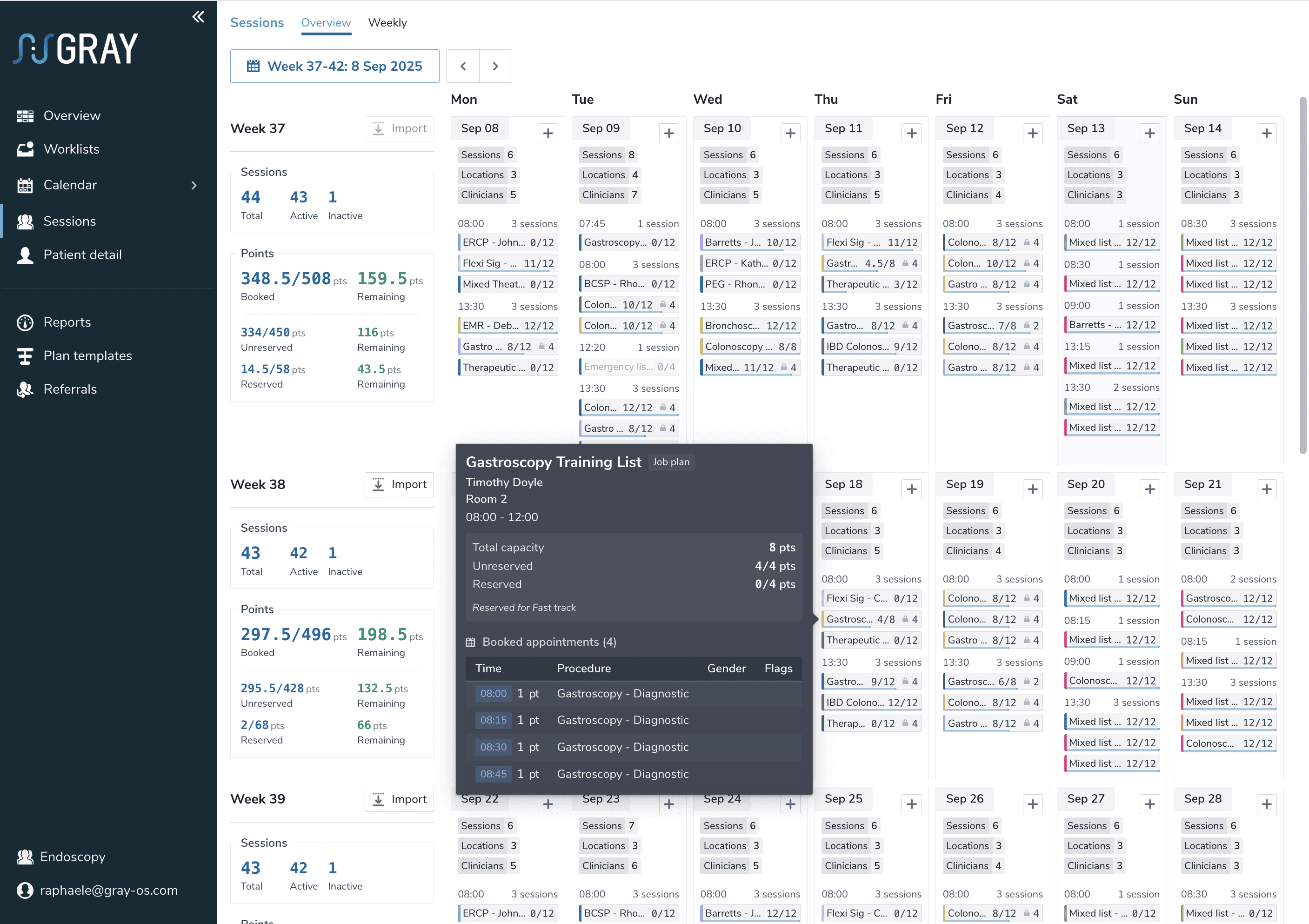
Sessions are built using a points-based capacity model. Each procedure carries a point value that reflects its clinical complexity and resource intensity, not its clock duration. A session has a maximum number of points it can absorb, which means that optimizing a session is a question of matching variable case mix against available capacity, not simply filling slots. This matters in endoscopy because procedure length varies significantly and overruns are common. Patient-clinician matching accounts for clinical priority, physician scope, and the specific requirements of each procedure. Priority levels run from routine referrals and surveillance follow-ups through urgent cases and Fast Track cancer pathways, each carrying distinct access targets. Reserved capacity within each session protects access for urgent cases without displacing the planned list, and those reserved points can be released as the session date approaches to avoid waste. Waiting list performance against the targets set by the Joint Advisory Group on GI Endoscopy (JAG), the national quality standard for endoscopy services in the UK, is tracked continuously, and the reporting required for those audits is generated directly from the system. The module integrates with existing clinical systems where available, reducing manual data entry across the care pathway.
The result is that coordinators work from a shared operational picture rather than distributed individual knowledge. The list is visible, auditable, and manageable in real time.
The HICSS Partnership
GrayOS for Clinics was developed in response to a gap that HICSS identified in the market: no existing solution managed clinical session capacity in a way that reflected how these units actually operate. HICSS integrated the module within its endoscopy management system and is responsible for deployment and training across NHS trusts in the UK and Ireland. The Tameside and Glossop deployment is the first go-live under this partnership. Several other NHS trusts are currently in preparation, with additional deployments expected over the coming months.
The Same Equation, a New Setting
Radiation therapy departments, systemic therapy departments, and outpatient clinics operate differently. The constraints are different, the resources are different, and the workflows are different. But the underlying problem is the same: patient demand must be continuously matched against finite capacity, within systems that were not designed to manage that equation efficiently.
GrayOS for Clinics is now available for outpatient clinics, whether standalone or part of a health system, looking to bring that same operational infrastructure to their outpatient appointment management.